Basco loves Jordan

Meet Arnaud “Basco” Elissalde, 82. He watches over the fire hall in Jordan, Mont.
Basco is from the Basque region of France, which he left in 1950, landing first in Miles City, and finally Jordan in 1968. He’s done a lot of odd jobs and ranch work and he even spent 10 lonely years as a sheepherder on the east Montana plains.
Basco says he spends a lot of his time these days sitting at a table waiting for a cribbage game or card game to walk in. Once in a while, he gets back to France to visit his five sisters, most recently two years ago.
Still, his heart remains in the austere region he calls home and others know as The Big Dry or The Big Empty. “I’ve never seen as nice a place as this one,” he says of Jordan.
He says he’s never married. Kids? “I hope not.”

The state of bees
Honey bees are important links in the food chain of the world. Not only do they supply sweet spreads for toast, they are also key pollinators for a host of crops. And they’re in trouble.
Something called Colony Collapse Disorder is wiping out huge numbers of bees around the world, including our little corner of heaven here in the United States. But scientists at the University of Montana in Missoula and Montana State University in Bozeman are at the cutting edge of finding the cause — and eventually the cure — for CCD.
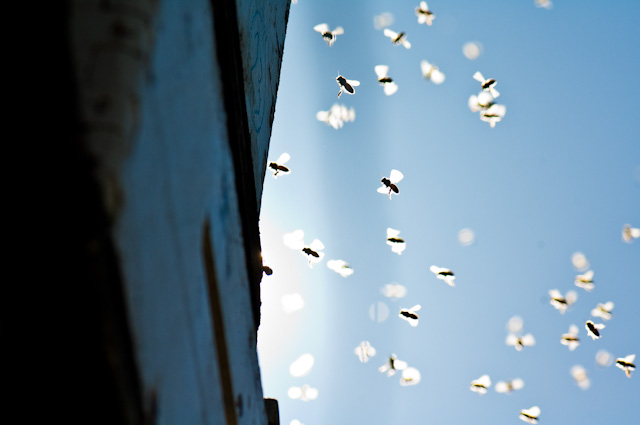
According to the U.S. Department of Agriculture, bees like these waiting to be unloaded in Wolf Point, Mont., add $15 billion a year to the value of American crops. The bees pollinate crops like berries, fruits, vegetables and nuts — particularly the almond groves of California, which produce 80 percent of the world’s supply.
Honeyland, Inc., owner Craig Rodenberg says his bees travel the West during the year, as different crops come into flower.
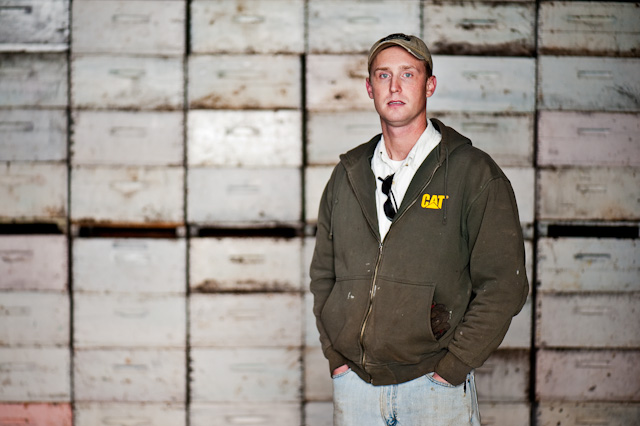
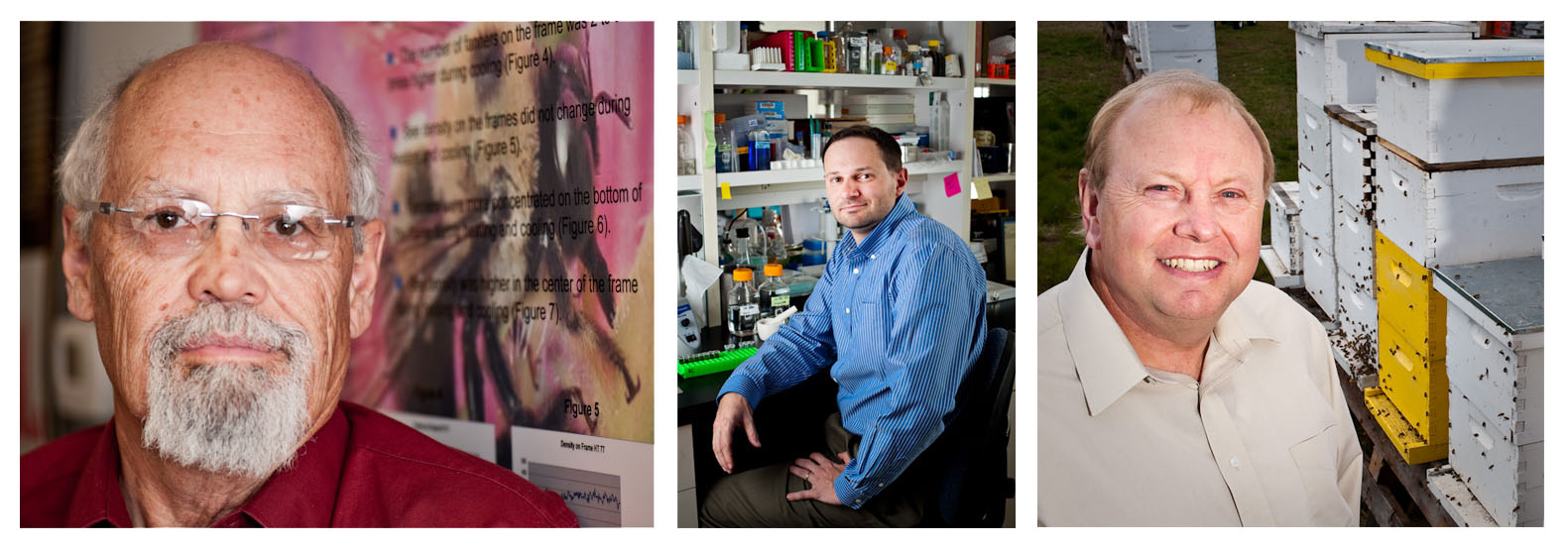
Rodenberg, 36, is a fourth-generation beekeeper in Wolf Point and also president of the Montana Beekeepers Association. “Officially, we lost 81 percent of what we sent down to California this year,” he says. “We’ve never come close to that before.”
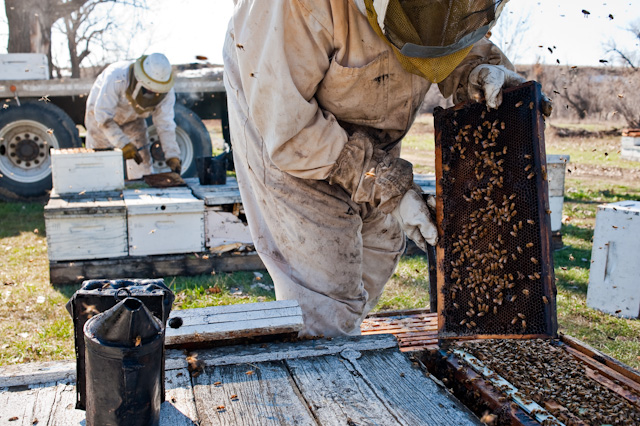
Workers scrape honey bees off of select frames inside Honeyland’s beehives. The workers replaced the nearly-empty frames with frames full of honey so that the bees would have something to feed on until nearby crops begin to bloom.

Peggy Lehmann is a senior research technician in a Montana State University lab in Bozeman. She is isolating Nosema cerabae spores from honey bees infected with CCD in order to be able to grow the fungus in the lab so it can be more closely studied. N. cerabae is thought to be one of the causes of CCD.
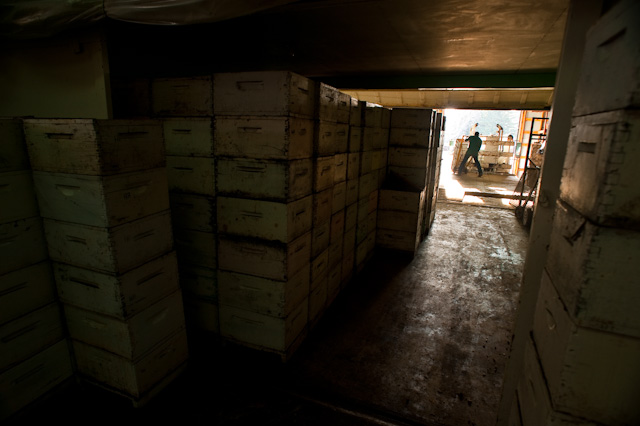
Boxes of beehives await occupants at Honeyland, Inc., in Wolf Point. The hives will get new queens, purchased in an effort to repopulate after suffering decimating losses in California this winter.
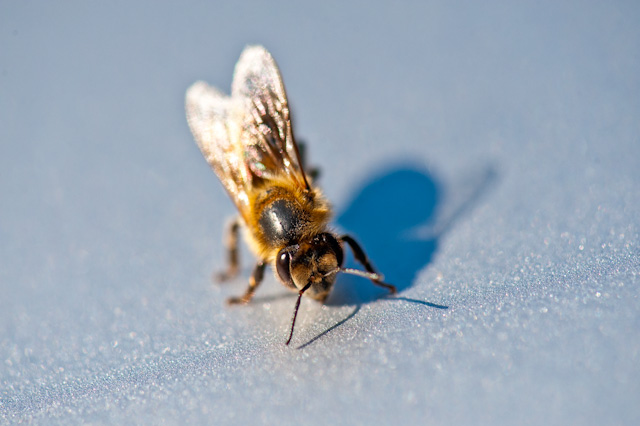
A honey bee gets its bearings after arriving in Montana from a winter in California.
Crow Fair

Colgate University asked me to attend the Crow Fair on Sunday for their alumni magazine, The Scene. They’re doing a story on Eric Noyes and the American Indian Institute. It was a treat for me. I hope you like it too.
“Language organizes thought”
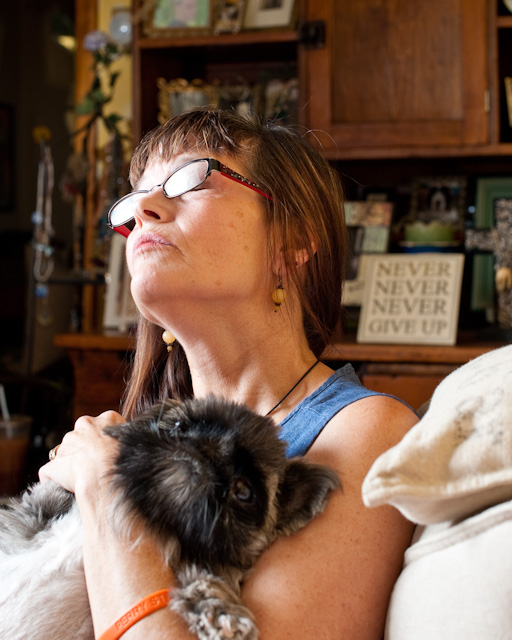
So says Montana’s new Poet Laureate, Sheryl Noethe, from her home in Missoula. “If I have feelings that I’m unclear on, if I put them into poetry, then they become clear.”
Noethe says she felt invisible growing up in Minneapolis until a teacher believed in her during the fifth grade. “She told me, ‘You are going to be an author,'” Noethe says. “It rewrote my entire life. That is a gift that comes once in a few lifetimes and my mission is to give it back to the kids.”
As Poet Laureate, Noethe will work toward teaching American Indian literature in Montana schools — especially ones in rural and underfunded areas. She plans to visit schools and produce podcasts so that as many people as possible have access to Indian poetry.
“Everyone deserves to be a poet,” she says. “It’s nobody’s job to tell someone to stop trying. It’s a waste of imagination. We need poetry. It provides solace, deep understanding of the self, deep perspective on a crazy world and the affirmation of beauty.”
Noethe says she has worked in the toughest neighborhoods in America, teaching kids to love to write poetry. She was active in the Teachers and Writers Collaborative in New York City and is now artistic director of the Missoula Writing Collaborative, which she estimates has reached 20,000 youngsters over its 17-year history.

Speaking his mind, no matter the cost
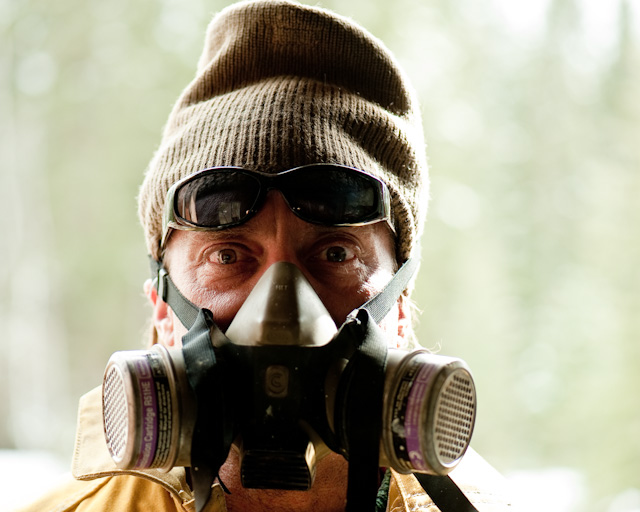
Stephen Braun is a sculptor who lives in northwest Montana. Braun’s art calls out corporate greed, environmental ignorance, societal gluttony and other present-day sins in a confrontational, no-holds-barred way.
Living as a radical liberal in a conservative area of the state has presented its problems. Braun says he has received death threats. So he insisted on wearing a ventilator, stocking hat and sunglasses for his portrait to protect his identity.
Hey, I live here
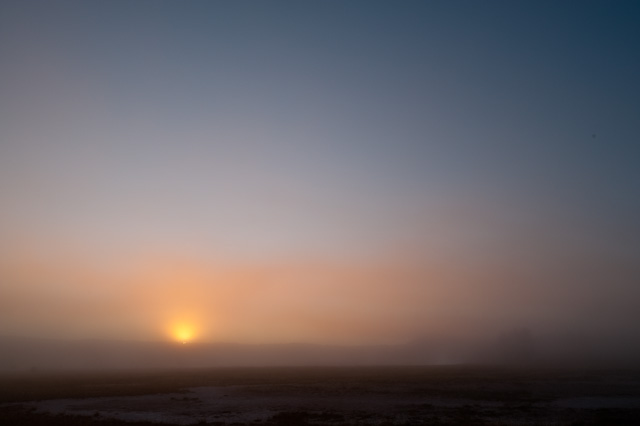
I’ve been a freelance photographer now for about a week and a half and I’m really digging it. We’ve been catching up on a bunch of long-delayed projects and it feels great. But Rena pointed out the other day that I haven’t made any pictures. So she hustled me off to Yellowstone Wednesday morning because, well, we live here and we can.
So here’s what I brought back. It was great to go just for myself, with no agenda and no newspaper or magazine holes to fill. I hope you like the pictures.
Update
Please check out my freshly-updated website. There’s a lot of new work up, much of which was posted first on this blog.
Under Butte
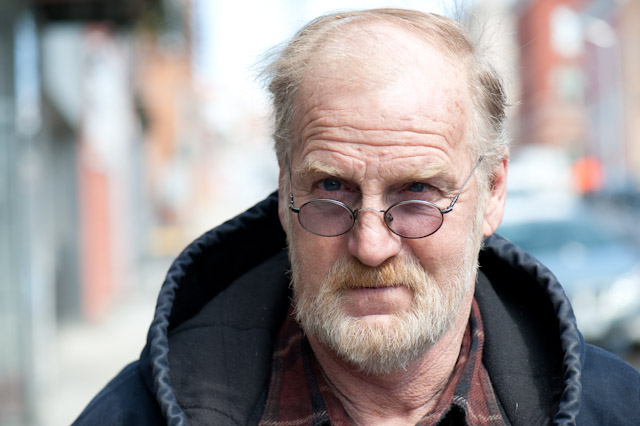
Bob McMurray runs Old Butte Historical Adventures in Butte, Mont.
“Butte (Mont.) had a population of more than 100,000 people in the early 1900s,” says local historian Bob McMurray. “It was bigger than Seattle.” It built a skyscraper of eight stories in 1901, one year before New York City had one that big, and had electricity in 1881, the third city in the country to do so, again before New York.
But it all had a cost. The copper mines that financed all of this advanced technology and wealth also polluted the air so badly that Butte’s street lights stayed lit all day. Acid rained from the sky. Butte began to expand underground. A business district under the sidewalks of uptown Butte peaked at more than 130 businesses, some of which operated into the 1960s and 1970s.
These days, McMurray takes people on tours to the businesses that are still there and tells the stories he has uncovered.
Elouise Cobell is a Winner
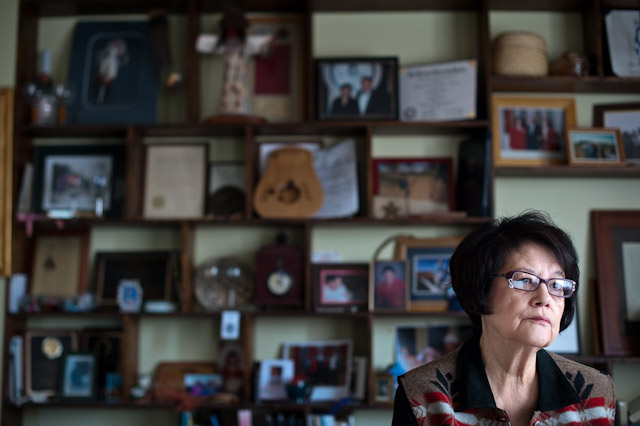 Elouise Cobell is a soft-spoken Blackfeet Indian who just happens to have sued the United States government on behalf of 500,000 American Indians — and won. It took 15 years, but persistence brought Mrs. Cobell to the office of President Obama on Dec. 8, 2010. There she watched Mr. Obama sign a measure granting a $3.4 billion settlement to American Indians for past government fiscal incompetence and corruption.
Into the Sunset
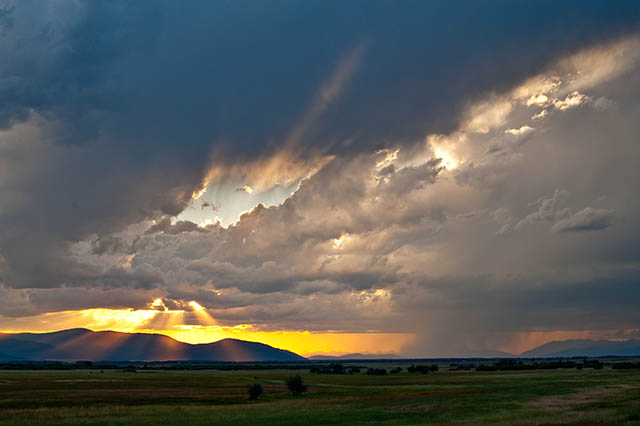
Monday will be my last day at Big Sky Publishing here in Bozeman, Mont.
I started in December 1999, worked for the Bozeman Daily Chronicle for nearly five years, then went to the newly-formed niche division in September 2004. There I authored two coffee-table books of photography, one on Bozeman’s historic architecture and one on Yellowstone National Park, filled up monthly inserts into the Chronicle that included a women’s magazine, an architecture magazine and a business journal, and helped to launch Montana Quarterly magazine, which first published in the summer of 2005.
It’s been a dream to photograph the wonderful places and people that make up this state — and to get paid for it, with benefits. And the people I’ve worked with have become great friends.
And now it’s time to move on. I’m nurturing three businesses now. There’s my commercial photography business which will continue and expand my work celebrating the rugged beauty of this place, there’s Montana Photography Workshops, which I founded with my friend and mentor Doug Loneman, and there’s GlowArtworks, an online art gallery I’ve founded with eight other artists from around the country.
I’m thrilled with the possibilities this move opens for me and for my family.
Stay tuned.
 Thomas Lee True West