My friend Kate
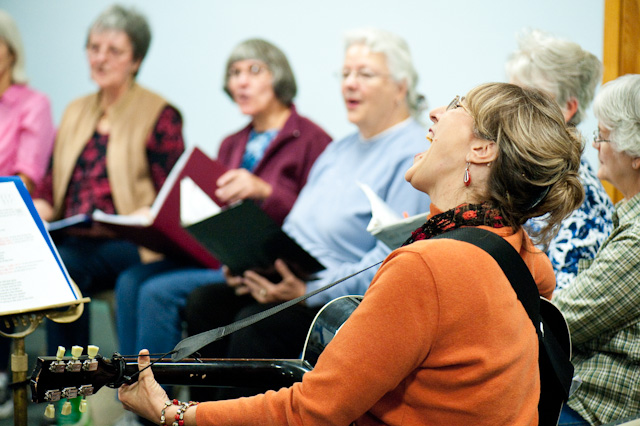
My friend Kate Bryan is a wonderful music teacher. She takes people of all ages and shows them joy through music. She’s one of those people whose fun personality is infectious. It’s good to live in a world with Kate in it.
Rural Post
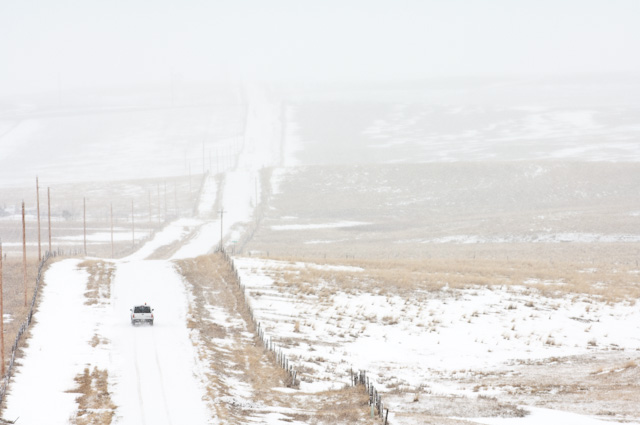
Meet Robin Puckett, who retired recently after 26 years delivering the mail in the rural area around Ryegate, Montana. Puckett’s route defines the term, “rural route,” and over the past three decades she has learned to be remarkably self-sufficient. She knows the best way to get through snow drifts, when to navigate through a farmer’s field instead of take the road, and how to make emergency vehicle repairs in the middle of nowhere.
My friend Al Kesselheim wrote the piece about Robin in the current issue of Montana Quarterly. I recommend it.
Shameless Self Promotion
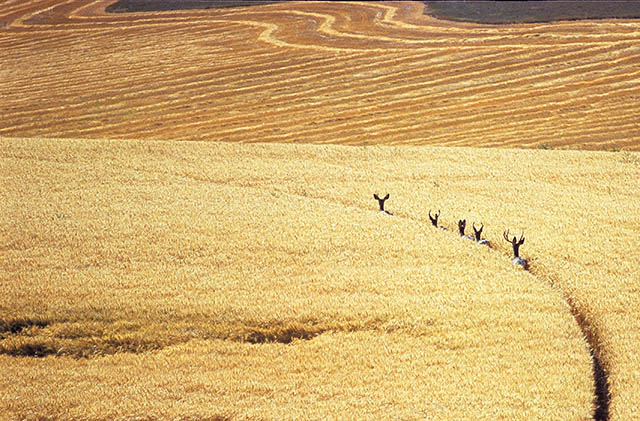
The fine folks at Shutterbug Magazine have put their April issue on the newsstands and I am flattered to say that at the bottom of Page 28 is a short blurb on yours truly by Joe Farace.
“Thomas Lee’s site contains five different portfolios showing breathtaking images of a state noted for breathtaking vistas, something that’s not always so easy to capture on film or silicone,” Joe says.
Aw, shucks. Thanks, Joe.
The Inverness Supper Club
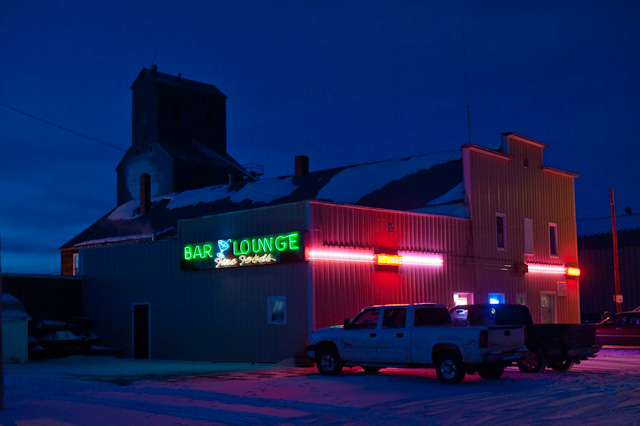 Way up on the Hi-Line, between Chester and Havre, lies the tiny town of Inverness, population 50. Inverness’ school closed a few years ago and now there’s not much there except Shawn and Elton Byxbe’s Inverness Supper Club. People come regularly from 50 miles away and farther because of the supper club’s reputation for good meals and friendly service, established by Shawn’s parents when they bought the place in 1961.
Ahh…A Thaw
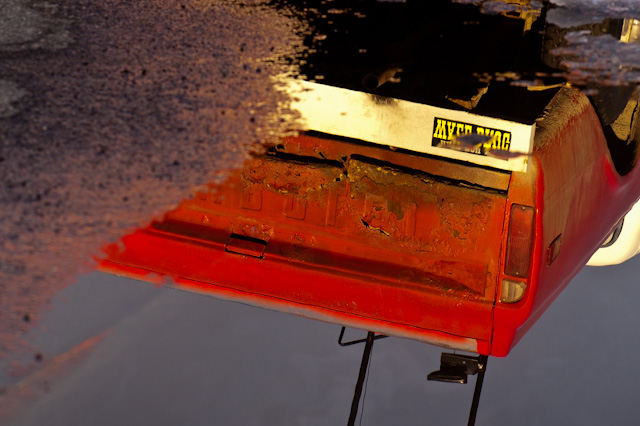
A long winter is finally coming to a close here in Montana. Warm sunshine is melting piles of snow, leaving big puddles along the curbs that reflect parked vehicles in a slushy, oily mirror.
Tribal Rivalry
 The Northern Cheyenne and Crow Indian tribes have a long combative history. Most notably perhaps, the Northern Cheyenne sided with the Lakota Sioux and the Crow were scouts for Custer during the Battle of the Little Bighorn.
Nowadays, they occupy neighboring reservations in Montana and Lodge Grass and Lame Deer are high schools on those reservations. Basketball has taken on an important role in Indian culture and they take it seriously. So writer Jeff Welsch and I went down to Lodge Grass last month to find out how the two tribes are taking their historic rivalry onto the hardwood for the Spring issue of Montana Quarterly.
New Montanan
 Meet Jack Dylan Rainey, born on Feb 13, 2011, weighing in at 7 lbs 6 oz., to Trina and Neal Rainey of Bozeman. Jack is all of 10 days old in this picture. Welcome to the Last Best Place, Jack.
Senior Rodeo — When old age doesn’t hurt enough on its own
When Billy Stockton woke up last July after a month in a Seattle hospital, he learned he had died twice right there in the Drummond rodeo arena, broken his neck in two places, broken every bone in his face, and mashed his optic nerve.
The 63-year-old career rodeo rider and outfitter was blind and his hearing was severely damaged. He spent another two months in the hospital in Seattle and then came home to Butte.
Nine months after Stockton flew off the back of a bucking horse and landed in a bloody mess at the Drummond senior rodeo, attendants come into his home to help him. They guide him from one room to another, take him for short walks around the neighborhood. He spends most of his time lying on top of his bed, listening to books on tape.
He leans back in one of the two matching recliners that make up his living room furniture. The high school he attended the year it first opened is only a couple of blocks from the front window he can no longer see through. He says he misses seeing the wildlife, he has a hard time finding his way around his own house and he still can’t hear very well.
“I can’t do nothing,” Stockton says. “Hell, it’s a job just to get dressed.”
But he’s not crying about it.
“I used to be pretty hard to satisfy when I could see and stuff,” he says, “but I could go and do whatever the hell I wanted to do. Now I can’t do that so taking the simpler things is making me happy now. It just don’t come automatic to be happy. But I just try and be as happy as I can because there’s no sense in being sad. It’s not gonna change anything.”
This summer, at several National Senior Pro Rodeos in Montana, someone else old enough to know better will tie himself to the back of an angry animal weighing a ton or more and try to ride it for eight seconds. He probably won’t last that long. He’ll probably get launched into the air and land on ground that gets harder every year, absorbing the impact with bones growing ever-more brittle. He’ll have to roll and run to keep from being stepped on or gored and climb huffing and puffing up a few rungs on the fence surrounding the arena.
He might even be bleeding.
And chances are he’ll be smiling from ear to ear.
“There’s bumps and blemishes along the trail,” National Senior Pro Rodeo Association president Bob Stoddard says, “but for the most part, we have very few people that get hurt seriously.”
The cowboys are all over 40. Some in their 60s are still riding bulls and broncos in the senior rodeos, and a few in their 80s are entered in the roping events. They come from the usual places, Montana, Wyoming, Idaho, but also from California, Arkansas and Missouri.
Stoddard says a lot of cowboys want to compete as young men, but the responsibilities of life get in their way. Now that they have a little more free time, they want to pursue their dream of a world championship. They want to see the country, be a part of the rodeo community.
“It’s a family,” Stoddard says, “and they’re good people. They like to compete and they like to beat you, but when it’s over we’ll all sit down and visit.”
And Billy Stockton is a part of that family. Stoddard says he was laughing and joking with Stockton five minutes before Stockton’s last ride.
“Billy is a dear friend,” Stoddard says. “It was a shock to the whole association, but that’s a tragedy. We sent moneys up there to help Billy with his hospital bills. Billy shared with everybody that getting hurt like that was unfortunate but he wouldn’t want it any other way.”
“No, I wouldn’t do anything different,” Stockton says. “Ida still got on bucking horses like I did. I might’ve got on a few more even. I don’t know.”
And for Stockton, there’s not a better feeling in the world than riding a bucking horse well, like he did in Billings a few years ago.
“That adrenaline was going through so much I couldn’t hardly sleep all night. It felt so good to ride a really good bucking horse and ride him right,” he says.
And rodeo cowboys have only themselves to answer to. They like the independence of deciding on their own what events to enter, which rodeos to travel to.
Still, there comes a time when the risks outweigh the returns.
Jack Mayn, who watched Stockton’s ill-fated ride in Drummond while preparing for his own bull ride, says the six bull riding events he entered last year at the age of 54 will last him. He came within one second of the whistle twice, but he’s now content to stay on as a deputy sheriff for Beaverhead County, train horses and play a little golf from here on out.
“I’m done,” he says. “I’ve satisfied my need and I’m smart enough to know I’m playing with fire. And if I’m playing with fire, I’m gonna get burned.”
Stockton says he knew that getting hurt is a part of rodeo. Before his wreck in June, he had broken ribs, legs, shoulders and arms.
“I’ve been around a lot of cowboys that broke their neck. I’ve got five friends in wheelchairs, but you just accept that. You just think, ‘well he got hurt. That happens to other people, that don’t happen to me.’ Because if you thought you was gonna get hurt or killed, you wouldn’t get on in the first place.”
But now in his living room, blind and partially deaf, Stockton says he doesn’t waste time complaining.
“There’s no sense of crying about it because you ain’t gonna change anything. And you can be either happy or sad and it’s a lot nicer to be happy than sad so you might as well be happy. There’s not a lot a helluva lot you can laugh about, but ya gotta kinda dink around and find what there is to laugh about cause being sad’s not gonna do ya any good.”
America The Beautiful
The other piece MA Bellingham asked me to make a slideshow for is America The Beautiful. Again, this is for the Bells of the Bridgers annual spring concert Sunday, Feb. 27, at 3 p.m., in the United Methodist Church at 121 S. Willson Ave. here in Bozeman, Montana.
It’s free.
And it should be quite a production. I’m told there will be five octaves of bells, handchimes, organ, piano and choir. Well worth your time if you’re in the neighborhood.
How Can I Keep From Singing
On Feb. 27, at 3 p.m., my friend MA Bellingham will lead the Bells of the Bridgers bell choir in their spring concert at the United Methodist Church in Bozeman. One of the numbers they’ll play is How Can I Keep From Singing and MA asked me to put together a slide show to go along. Here’s what I came up with. I would love to hear from anyone who cared to venture an opinion.
 Thomas Lee True West